

When we think about plastic pollution, most of us probably picture plastic bottles, bags, food packaging or other visible waste. However, Plastic pollution does not always remain visible.
Plastic products can gradually weather and break into smaller particles. Some of these particles become so small that they are difficult to see without magnification. These are broadly referred to as microplastics.
Over the last few years, microplastics have received increasing attention from scientists and environmental regulators. They have been reported in a wide range of environmental settings, including waterways, sediments, soils and air.
For me, one of the interesting things about microplastics is that they sit somewhere between the familiar problem of plastic waste and the more complex world of environmental contamination. We can easily see larger plastic items, but once it fragments, understanding where those smaller particles end up becomes far more difficult.
What are microplastics?
Microplastics are generally defined as plastic particles smaller than 5 millimetres.
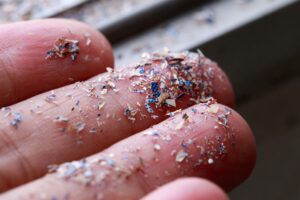
They are not all the same. Some may look like small fragments, while others occur as fibres, films, foams or pellets. They can also be made from different polymers, including polyethylene, polypropylene and polystyrene.
Their size can vary considerably. Some particles may be visible to the naked eye, while others are small enough that specialised laboratory techniques are required to identify them.
There is also a distinction between microplastics and nanoplastics. Nanoplastics are generally considered to be even smaller plastic particles, although there is still discussion within the scientific community about definitions and size ranges.
This variation matters because the behaviour of a plastic particle in the environment can depend on its size, shape, polymer type, weathering and other characteristics.
So, when we talk about “microplastics”, we are really talking about a broad group of particles rather than one particular contaminant.
How are microplastics produced?
There are several ways microplastics can enter the environment. Some are released as small particles. Others form when larger plastic items break down. The latter is relatively easy to understand. A plastic item exposed to sunlight, heat, physical abrasion and weathering can gradually become brittle and develop cracks. As degradation continues, larger pieces can fragment into progressively smaller particles. These are commonly known as secondary microplastics.
In contrast, primary microplastics enter the environment already in a small form. While the distinction between primary and secondary microplastics is useful, the key environmental concern is the same: plastic can enter the environment in a form that is small enough to be transported away from its original source. Once dispersed, these particles can move through air, water, and soils, making their distribution and potential impacts difficult to predict and manage.
Where do they come from?
Plastic packaging and discarded plastic waste are obvious sources, but they are certainly not the only ones.
Tyre wear
Vehicle tyres wear down during normal use. The friction between the tyre and road surface generates particles containing rubber, polymers and other materials. Some of these particles remain on the road, while others can be transported by rainfall and stormwater into drainage systems and waterways.
Research into tyre-wear particles has increased considerably in recent years because they represent an ongoing source rather than a one-off pollution event. A 2024 review by Miera-Domínguez et al. highlighted road runoff and other transport pathways as important considerations when assessing tyre-wear particles in the environment. It is an example of a source that most people would probably not associate with microplastic pollution.
Synthetic textiles
Synthetic clothing is another source of concern. Polyester, nylon and acrylic fabrics can release small fibres through normal use and washing. Some of these fibres enter wastewater and can subsequently be captured during wastewater treatment.
A review of fibrous microplastics published in 2024 identified synthetic textiles as an important source of microfibres to the environment and discussed their transport through wastewater and other pathways. This does not mean that putting a polyester shirt in the washing machine suddenly creates a major pollution event. The issue is the cumulative effect of many small releases occurring over a long period.

Paint and coatings
Paint and protective coatings are also being investigated as potential sources of microplastic particles. Buildings, roads, bridges, boats and other infrastructure are exposed to weathering and physical wear. As coatings deteriorate, small particles can be released to surrounding areas and potentially transported by wind or water.
Plastic waste
Poorly managed plastic waste remains another obvious source. A plastic container discarded into the environment does not necessarily remain as one large piece. Sunlight, temperature changes, abrasion and weathering can cause it to deteriorate and fragment over time. This is one reason why preventing plastic waste from entering the environment in the first place remains important.
Where do microplastics end up?
Once microplastics are released, they do not necessarily remain where they originated. Their movement depends on range of factors, including particle size, density, shape, surface characteristics and the environmental conditions around them.
For example, particles deposited on roads may be transported by stormwater runoff, while synthetic fibres can enter wastewater systems through everyday activities such as washing clothes. Particles deposited on land can also be redistributed by wind, rainfall, soil disturbance and biological activity. As a result, some microplastics eventually reach rivers, estuaries and coastal environments, while others may remain in soils or become incorporated into sediments.
From an environmental assessment perspective, this mobility is an important consideration. Focusing only on the original source of microplastics may not provide a complete picture of where they ultimately end up.
It is not only a marine issue.
Plastic pollution is often associated with oceans and beaches, and for a good reason. However, research over recent years has also highlighted the presence of microplastics in terrestrial environments, including soils.
One example comes from a 2024 review by En-Nejmy et al., which examined published studies covering 62 sites across 17 countries. Reported microplastic concentrations ranged from non-detectable levels to approximately 3.57 million particles per kilogram of soil. That figure requires careful interpretation. It would be misleading to suggest that soils generally contain millions of particles per kilogram. The studies included in the review differed in their sampling locations, soil types, sampling approaches and analytical methods. These differences make direct comparisons between studies difficult.
Nevertheless. the review highlights an important point: microplastics have been identified across a variety of terrestrial environments and that soil is an important part of the overall picture and should be considered alongside aquatic environments when assessing environmental risk.
How do microplastics get into soil?
There are several possible pathways through which microplastics can enter soil. In agricultural settings, plastic mulches can contribute particles as they weather and degrade over time. Wastewater and biosolids can also be relevant pathways, as can atmospheric deposition, litter and the breakdown of plastic materials already present on or within the land. Once microplastics enter soil, they may not remain at the surface. Their distribution can be influence by water movement, soil disturbance, and the activity of soil organisms.

Researchers are also investigating whether microplastics affect soil properties and biological processes. A 2024 review by de Souza Machado et al. discussed potential effects on soil organisms, plants and soil processes, while also highlighting that outcomes depend on the characteristics of the plastic and the conditions within the soil. This is an area where there are still many unanswered questions.
Part of this uncertainty reflects the complexity of soil systems. The behaviour of microplastics observed under controlled laboratory conditions may not fully represent how those particles behave in real-world environments.
Should we be concerned about environmental impacts?
There is evidence that organisms can be exposed to microplastics in a range of environments. Researchers have studied their effects on aquatic organisms, soil organisms, plants and microorganisms. Some studies have reported changes in growth, reproduction, feeding behaviour or other biological responses. However, findings are not always consistent, and reported effects vary between studies.
The characteristics of the particles matter, as do the concentration, duration of exposure and environmental conditions. It is reasonable to describe them as an emerging environmental contaminant and to recognise that they have the potential to cause environmental effects. It is less appropriate to assume that every microplastic particle will have the same effect or that laboratory findings can automatically be translated into environmental risk. The science is still emerging.
What do we know about human health?
This is probably the question that attracts the greatest public interest. Microplastics have been detected in environmental media to which people can be exposed, including food, water and air. As a result, there is growing scientific and public interest in whether such exposures could affect human health.
The World Health Organization (WHO) reviewed the available evidence on exposure to microplastics and nanoplastics through food, water and air and identified a number of important knowledge gaps (WHO, 2022). The key point is that exposure and health risk are not the same thing.
Finding microplastics in food, water or other environmental medium demonstrates that exposure can occur. However, it does not, by itself, establish that a particular level of exposure will cause harm. Important uncertainties remain around factors such as the amount of microplastics people are exposed to, how different particle types behave in the body and what exposure levels, if any, are associated with adverse health effects.
A statement published in Nature Reviews Gastroenterology & Hepatology similarly noted that although human exposure to microplastics is occurring, evidence demonstrating adverse effects on human health remained limited and further research was needed (van der Laan et al., 2023).
The presence of a contaminant does not automatically mean that a person is at a significant health risk.
What are we seeing in Australia?
Australia is also developing a clearer understanding of the distribution of microplastic contamination in the environment. In 2026, the NSW Environment Protection Authority (NSW EPA) released results from a broadscale assessment of microplastics in NSW coastal waterways. The assessment covered 120 waterways, and microplastics were detected in all 120 locations sampled. Reported concentrations ranged from 0.02 to 34.80 particles per cubic metre, with higher concentrations identified in some urban waterways. The study also found that particles smaller than 1 mm were particularly common (NSW EPA, 2026).
This is useful information because large-scale monitoring can help establish a baseline and identify areas where further investigation may be warranted. It also demonstrates that microplastics are not simply an overseas or marine issue. They are being investigated within Australian environmental systems as well.
What happens to microplastics during wastewater treatment?
Wastewater is another interesting example of how contaminants can move between environmental compartments. Wastewater treatment plants are designed to remove a wide range of pollutants before treated water is released. Microplastics can also be captured during treatment. However, capture is not necessarily the same as destruction.
A recent NSW EPA and CSIRO study investigated microplastics entering and leaving seven wastewater treatment plants. The study found that treatment reduced the concentration of microplastics discharged in treated wastewater, with most of the incoming particles appearing to be captured in biosolids (NSW EPA, 2026). If a contaminant is removed from wastewater but transferred into biosolids, the overall environmental pathway still needs to be considered.
In other words, the question is not about:
Did the treatment plant remove the microplastics?
It is:
Where did the microplastics go after they were removed?
That is a question environmental scientists are familiar with when assessing contaminants more broadly.
Why are microplastics difficult to measure?
One of the challenges with microplastics is that they are not particularly straightforward to sample and analyse. A routine soil or water sample cannot simply be sent to a laboratory with a request to “test for microplastics” in the same way that we might request a standard chemical analysis.
There are decisions to be made about the size range being investigated, the sampling approach, laboratory preparation and the analytical method. Researchers may also need to determine the type of polymer present and distinguish plastic particles from other materials. Results can be reported in different ways, such as particle numbers or mass concentrations. This makes comparisons between studies difficult.
The 2024 review by En-Nejmy et al. identified differences in sampling and analytical methods as one of the challenges in understanding the distribution of microplastics in soil. Improving consistency in sampling, analysis and reporting will therefore be important as microplastic monitoring becomes more common.
What can we do about it?
There is not one simple solution to microplastic pollution. Reducing the amount of plastic entering the environment in the first place is an obvious starting point. At an individual level, this can include reducing unnecessary single-use plastics, reusing products where practical, disposing of waste correctly and avoiding littering. For synthetic textiles, following appropriate washing and care practices may also help reduce fibre release. But individual behaviour is only one part of the picture.
There are also questions around product design, manufacturing, waste management, stormwater, wastewater treatment, recycling and the management of materials at the end of their useful life. This is why microplastic pollution is ultimately more than a litter problem. It is also a materials management and environmental contamination issue. Understanding how microplastics are generated, transported, and distributed throughout the environment can help identify where prevention and control measures are likely to be most effective.
While many questions remain, one point is clear: preventing plastic from entering the environment is generally easier than attempting to manage it after it has fragmented into millions of microscopic particles.
Why does this matter?
Microplastics are a relatively new area of environmental research, and many questions remain unanswered. We are still learning about how different types of particles behave in soil and water, how long they persist, how they move between environmental compartments and what concentrations may result in meaningful ecological or human-health effects. At the same time, there is already enough evidence to show that microplastics are widespread and that they can enter environmental systems through many different pathways. For me, that is what makes microplastics an important contaminant to understand.
Environmental contamination is not always something we can see. Sometimes the original plastic item is obvious, but the particles produced as it wears down are not. A tyre wearing down on a road, a synthetic fibre entering wastewater or a piece of plastic gradually fragmenting in soil may seem like relatively small events. When these processes occur repeatedly across large populations and over long periods, however, they become much more relevant from an environmental management perspective.
Microplastics are a reminder that the environmental footprint of a material does not necessarily end when we can no longer see the original product. Understanding where these particles come from, where they go and what happens when they get there will be an important part of managing plastic contamination in the years ahead.
References
- World Health Organization (2022). Dietary and inhalation exposure to nano- and microplastic particles and potential implications for human health. Geneva: WHO.
- En-Nejmy, K., El Hayany, B., Al-Alawi, M., Jemo, M., Hafidi, M. & El Fels, L. (2024). Microplastics in soil: A comprehensive review of occurrence, sources, fate, analytical techniques and potential impacts. Ecotoxicology and Environmental Safety, 288, 117332. https://doi.org/10.1016/j.ecoenv.2024.117332
- Microplastics in soils: A comprehensive review. (2025). Science of the Total Environment, 960, 178298.
- Unveiling the impacts of microplastic pollution on soil health: A comprehensive review. (2024). Science of the Total Environment, 951, 175643.
- Microplastic contamination, an emerging threat to the freshwater environment: A systematic review. (2024). Environmental Systems Research, 13, 8.
- Miera-Domínguez, H., Lastra-González, P., Indacoechea-Vega, I. & Castro-Fresno, D. (2024). What is known and unknown concerning microplastics from tyre wear? Road Materials and Pavement Design, 25(8), 1658–1679.
- A review of tire wear particles: Occurrence, adverse effects, and control strategies. (2024). Ecotoxicology and Environmental Safety, 283, 116782.
- Fibrous microplastics in the environment: Sources, occurrence, impacts, and mitigation strategies. (2024). Aquatic Toxicology, 107119.
- NSW Environment Protection Authority (2026). Broadscale microplastic assessment. NSW EPA.
- NSW Environment Protection Authority (2026). Microplastic quantification in wastewater. NSW EPA.